
Rat models
Animal models continue to be important tools for understanding disease mechanisms and for preclinical testing of potential therapeutics. Although the mouse is currently the most widely used species to model neurobiological disorders, we recognize that other model systems may also provide important insights.
Relative to the mouse, the rat has a larger brain and exhibits a more complex behavioral repertoire but still retains many tractable characteristics that make it amenable for laboratory research. Rats are sometimes falsely perceived as slightly larger versions of mice; however, the evolutionary distance between rats and mice may be as great as that between humans and Old-World monkeys1. Recent developments in genomic-editing technologies have facilitated the ability to manipulate the rat genome, thus spurring interest in the rat as a model for genetically linked disorders.
As such, SFARI worked with the Medical College of Wisconsin (MCW) to generate and distribute CRISPR/Cas9 rat models of autism. Models will be maintained in the outbred Long-Evans background strain, as this is often the strain of choice for cognitive, behavioral and systems neuroscience studies. The intent is for these models to be available to any qualified researcher, with minimal cost and restrictions. An MCW guide to maintaining outbred colonies can be found here.
In addition, researchers at the Simons Initiative for the Developing Brain (SIDB) at the University of Edinburgh have generated additional rat models of autism, including conditional re-expression and inactivation lines for key autism genes. SIDB works with the University of Edinburgh’s Biosciences and Veterinary Services (BVS) Central Transgenic Core to generate these rat models, some of which are still being validated. The validated rat models of autism can be requested by emailing SIDB: [email protected].
Models Available From MCW
- Arid1b heterozygous knockout, behavioral data sheet
LE-Arid1bem1Mcwi - Chd8 heterozygous knockout
LE-Chd8em1Mcwi - Cntnap2 knockout
LE-Cntnap1em1Mcwi - Dyrk1a heterozygous knockout
LE-Dyrk1aem3Mcwi - Fmr1 knockout
LE-Fmr1em2Mcwi, behavioral data sheet - Grin2b heterozygous knockout, behavioral data sheet
LE-Grin2bem1Mcwi - Nrxn1 knockout
LE-Nrxn1em1Mcwi - Scn2a heterozygous knockout, behavioral data sheet
LE-Scn2aem1Mcwi
For more information on these models and how to request them, please contact the MCW Gene Editing Rat Resource Center: [email protected].
Models Available From SIDB
- Cdkl5 knockout2,3
LE-Cdkl5em1Sidb - Fmr1 knockout4–6
LE-Fmr1em1Sidb - Syngap1 heterozygous knockout7-9
LE-Syngap1em1Sidb - Syngap1 Δ-GAP: deletion at the C2/GAP domain7,8,10,11
LE-Syngap1em2Sidb - Grin2a knockout12,13,14
LE-Grin2aem1Sidb
In production/validation:
- Champ1 knockout
LE-Champ1em1Sidb - Nlgn3 knockout
LE-Nlgn3em1Sidb - CAG-Cre_ERT
- Fmr1 cON
LE-Fmr1em2Sidb - Syngap1 cON
LE-Syngap1em3Sidb - Nlgn3 cON
LE-Nlgn3em2Sidb - Fmr1 FLOX
LE-Fmr1em3Sidb - Nlgn3 FLOX
LE-Nlgn3em2Sidb - Syngap1 FLOX
LE-Syngap1em4Sidb
For more information on these models and how to request them, please contact SIDB: [email protected].
Additional SFARI-Funded Models
SFARI funded a grant to Yann Herault (Institut de Genetique et de Biologie Moleculaire et Cellulaire) to generate a rat line containing a deletion (on rat chromosome 1) homologous to the human 16p11.2 BP4-BP5 region in the Long-Evans (LE) strain using CRISPR/Cas9. This model is currently available on www.infrafrontier.eu.
- 16p11.2 del
Rno1Del(Sult1a1-Spn)
Characterization
As an initial effort to characterize these lines, these models are being behaviorally phenotyped through a partnership with the Simons Initiative for the Developing Brain (SIDB) at the University of Edinburgh. Rat models are phenotyped according to a rigorous pipeline that assesses behaviors relevant to autism spectrum disorder, such as social and motor skills, learning and sensory processing (see methodology here). Different cohorts of rats are run through different subsets of tasks to overcome potential order effects on behaviors and to limit the number of tasks each animal is put through. Resulting data will be available pre-publication via downloadable behavioral datasheets (see links to available datasheets above).
The SIDB behavioral pipeline includes the following tasks:
Learning and memory
- Auditory and visual fear conditioning (Pavlovian fear conditioning)
- Water maze (spatial learning and memory and reversal learning)
- Object recognition task (non-spatial recognition memory)
- Object location recognition task (spatial recognition memory)
- Active place avoidance (allocentric spatial learning and memory, cognitive control, cognitive flexibility)
- Prey-capture task (complex learning, involving various cognitive processes and sensorimotor learning)
Social behavior
- Juvenile paired play paradigm (developmental social behavior)
- One-trial social task (adult social behavior)
Other behaviors
- Pup righting task (neurodevelopmental reflex)
- Marble interaction task (novel object interaction)
- Hind paw/hairy back tape test (Peripheral tactile reactivity)
In addition, prior to pipeline phenotyping, some rats are characterized using the following experimental set-ups/methods:
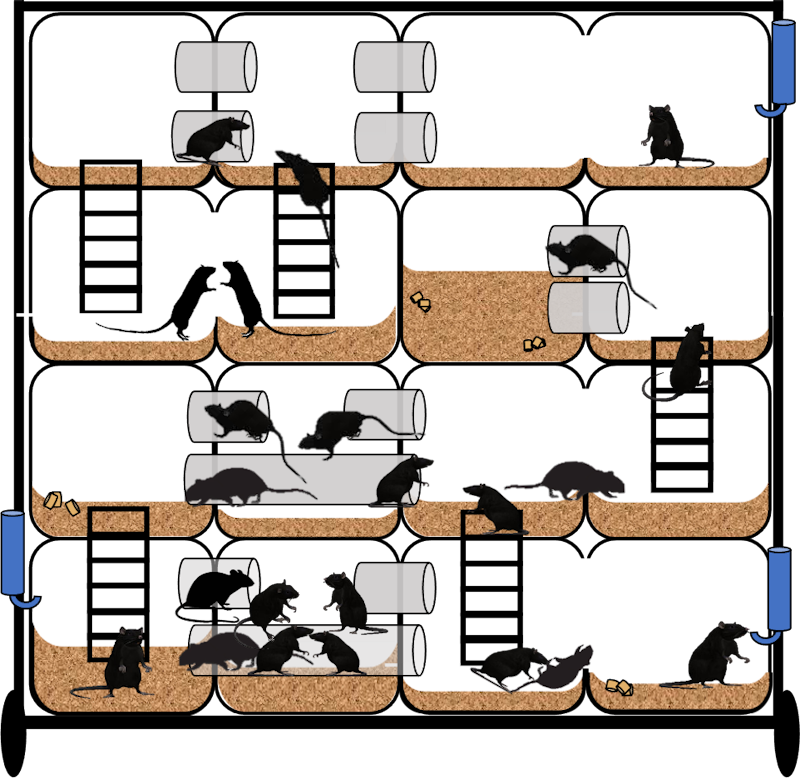
Habitat
Eco-ethological housing system that permits rats to express a wide-range of innate behaviors that can be recorded and analyzed without disturbing animals.
Motion sequencing (Moseq)
Automated, machine-learning-based method developed by Sandeep Robert Datta and colleagues to characterize behavior in rodents (mice and rats)2. More information about this tool can be found here.
For suggestions and comments on our efforts more generally, please contact SFARI: [email protected].
References
- Gibbs R.A. et al. Nature 428, 493-521 (2004) PubMed
- Simões de Oliveira L. et al. Mol. Autism 15, 28 (2024) PubMed
- Kontaxi C. et al. J Neurosci. 43, 2002-2020 (2023) PubMed
- Bonnycastle K. et al. J Neurosci. 42, 1618-1628 (2022) PubMed
- Asiminas A. et al. Mol, Autism. 13, 49 (2022) PubMed
- Ramesh V. et al. Glia 73, 1203-1220 (2025) PubMed
- Katsanevaki D. et al. Cell Rep. 43,114733 (2024) PubMed
- Bonnycastle K. et al. Mol. Autism. 16, 26 (2025) PubMed
- Mastro T.L. et al. Elife 9, e52656 (2020) PubMed
- Buller-Peralta I. et al. Brain Commun. 4, fcac263 (2022) PubMed
- Harris E. et al. Eur J Neurosci. 54, 7733-7748 (2021) PubMed
- Strehlow V. et al. Brain 142, 80-92 (2019) PubMed
- McKay S. et al., Cell Rep. 25, 841-851.e4 (2018) PubMed
- Yasmin F. et.al. Brain Commun. 7, fcaf124 (2025) PubMed
- Wiltschko A.B. et al. Neuron 88, 1121-1135 (2015) PubMed