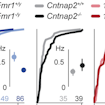
Dan Feldman and colleagues analyzed four mouse models of autism and found that alterations in the excitation-inhibition ratio may serve as a homeostatic mechanism to prevent network hyperexcitability.

Dan Feldman and colleagues analyzed four mouse models of autism and found that alterations in the excitation-inhibition ratio may serve as a homeostatic mechanism to prevent network hyperexcitability.

SFARI is pleased to announce that it intends to fund 15 grants in response to the Winter 2019 Pilot Award request for applications (RFA).

Grants awarded through this RFA are intended to provide early support for exploratory ideas, particularly those with novel hypotheses for autism. Appropriate projects for this mechanism include those considered higher risk with less assurance of ultimate impact, but with the potential for transformative results.

New data were recently added to SFARI Gene. This data release included updated gene scores for candidate autism risk genes, as well as the addition of new genes and copy number variant loci associated with autism. New mouse and rat models were also added.

Autism BrainNet is now distributing frozen and fixed postmortem brain tissue from individuals with autism spectrum and other neurodevelopmental disorders, as well as neurotypical individuals, for use in research studies. Researchers from all over the world are eligible to apply.

A new, improved version of SFARI Base that streamlines and facilitates the process whereby researchers can request access to SFARI data and biospecimens as well as the submission of research recruitment requests, has launched.

On February 22, 2018, SFARI organized a workshop on the uses of digital tools for phenotyping cognition and behavior in brain disorders. Goals of the workshop included learning more about technologies that can reproducibly and accurately measure autism-relevant behaviors and discussing how the tens of thousands of participants recruited through SPARK can help to collect data on and phenotype autism behaviors at scale.

New data were added to SFARI Gene in November 2018. This data release included updated gene scores for candidate autism risk genes, as well as the addition of new genes and copy number variant loci associated with autism. New mouse, rat, zebrafish and Drosophila models were also added.

SFARI is pleased to announce that it has selected four awardees in response to the 2018 Bridge to Independence Award request for applications. This program helps early-career scientists transition from mentored training positions to independent careers in autism research.

This issue of the SFARI newsletter includes: (1) SFARI 2018 Explorer awardees announced, (2) Research opportunities at family meetings of rare, genetic developmental disorders, (3) SFARI workshop revisited the excitation-inhibition hypothesis of autism, (4) SFARI workshop highlighted chromatin-associated proteins and autism risk, (5) 2019 SPARK Clinical Site Network – Request for applications, (6) 2019 Research Awards – Request for applications, (7) Upcoming lecture: André Fenton, “Rethinking autism and animal models: A systems perspective”, (8) Upcoming lecture: Pawan Sinha and Dagmar Sternad, “The predictive impairment hypothesis in autism: An empirical assessment”.