Normal brain development depends on precisely coordinated signals, many of which are delivered through the cerebrospinal fluid (CSF). CSF not only cushions the brain but contains a multitude of factors that help guide its development in utero and support the central nervous system throughout life1,2. Most CSF is produced, and its protein composition determined, by the epithelial cells of the choroid plexus (ChP), a highly vascularized tissue that lines the ventricles of the brain1,3,4. Interfering with the CSF proteome has been shown to impair the generation of neural progenitors and cause brain abnormalities5. However, how ChP cells control the secretory processes that determine CSF makeup remains unclear.
Embryonic ChP expresses high levels of HTR2C, the gene that encodes the serotonin receptor 5-HT2C. Activation of this receptor increases calcium activity, which is one way cells may modulate secretion6. SFARI Investigator Maria Lehtinen and colleagues therefore hypothesized that pharmacologically activating this receptor might, by way of calcium, cause increased secretion of signaling factors into the CSF and thereby influence the development of the cerebral cortex.
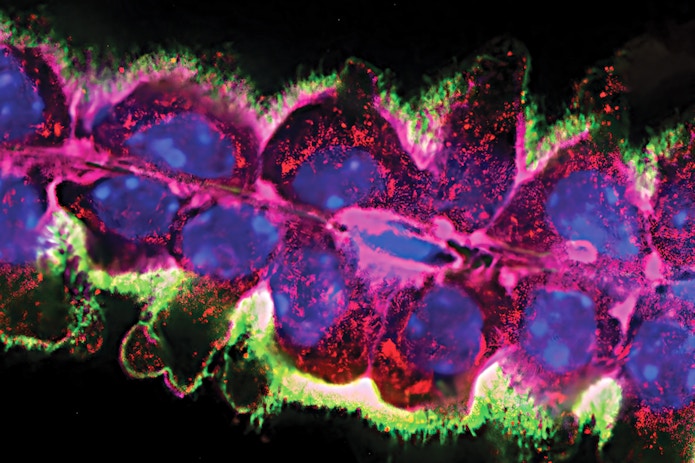
Using a selective 5-HT2C agonist, the team demonstrated that activation of the serotonergic 5HT2c receptors led to an increase in intracellular calcium, early-response gene expression and elevated protein secretion into the CSF. They further identified apocrine secretion as the principal mechanism by which ChP cells modify CSF composition. Apocrine secretion is a process in which a portion of the cell’s membrane and cytoplasm bud off, releasing their contents into the extracellular space7. When pregnant mice were administered the serotonergic agonist, their offspring were affected in several ways. In utero exposure induced ChP-mediated apocrine protein secretion into the CSF, shifted neural progenitor programs and resulted in abnormal cortical development. By adulthood, these mice exhibited social deficits and repetitive behaviors.
The study also shows that the developing cortex may also be vulnerable to other serotonergic activators, such as the psychedelic LSD, as maternal LSD exposure triggers embryonic apocrine secretion, and maternal immune activation can cause increased apocrine secretion. Additional pathways that induce ChP secretion could likewise influence neurodevelopment. For example, fevers during pregnancy may activate heat-sensitive TRPM3 channels, also known to induce ChP secretion, which could explain certain neurodevelopmental disorders associated with maternal fever. The authors note that understanding this system could help protect against adverse prenatal exposures to a variety of sources and make it possible to leverage the ChP’s secretory machinery for therapeutic benefit. In addition, because ChP apocrine secretion persists into adulthood and can be triggered through similar pathways, it may help support brain health throughout life.
- Silva-Vargas V. et al. Cell Stem Cell 19, 643–652 (2016) PubMed
- Saunders N.R. et al. Physiol. Rev. 103, 919–956 (2023) PubMed
- Damkier H.H. et al. Physiol. Rev. 93, 1847–1892 (2013) PubMed
- Lun M.P. et al. J. Neurosci. 35, 4903–4916 (2015) PubMed
- Lehtinen M.K. et al. Neuron 69, 893–905 (2011) PubMed
- Watson J.A. et al. Cell Calcium 17, 120–128 (1995) PubMed
- Farkaš R. Biochim. Biophys. Acta. 1850, 1740–1750 (2015) PubMed