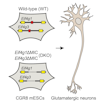
Gaia Novarino and Joseph Gleeson find impaired amino acid transport into brain causes ASD-like symptoms in mice, and uncover transport mutations in individuals with ASD.
Gaia Novarino and Joseph Gleeson find impaired amino acid transport into brain causes ASD-like symptoms in mice, and uncover transport mutations in individuals with ASD.
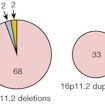
Evan Eichler reconstructs the evolution of chromosome 16p11.2 and finds most disease-causing rearrangements map within a H. sapiens-specific duplication containing BOLA2.

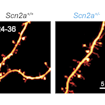
Kevin Bender, Stephan Sanders and colleagues show that there is an unexpectedly critical role for the autism risk gene Scn2a, which encodes the sodium channel NaV1.2, in postnatal dendritic excitability and synaptic function in mice.

Autism BrainNet has established a new collaboration with the Douglas-Bell Canada Brain Bank. This alliance will allow Canadian individuals and families the opportunity to consider making a postmortem brain donation to help advance autism research.

A joint project of the Foundation for Angelman Syndrome Therapeutics (FAST) and SFARI, the International Angelman Syndrome Research Council (INSYNC-AS) held its inaugural meeting on July 9, 2021.

The Simons Foundation Autism Research Initiative (SFARI) is pleased to announce the funding of 23 projects as part of its 2024 Pilot and Pilot Progression awards. Awards from the 2024 cycle will provide over $9 million in total funding to 18 Pilot awards and 5 Pilot Progression awards.

The Simons Foundation Autism Research Initiative (SFARI) is pleased to announce the recipients of its Autism Rat Models Consortium 2.0 grants. This grant program will expand on the work done by the original Autism Rat Models Consortium.

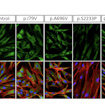
Michael Piper and colleagues confirmed and extended the association of USP9X loss-of-function mutations with a neurodevelopmental syndrome in both sexes, driven by changes in multiple signaling pathways.

Benjamin Blencowe and colleagues defined the functional roles of microexons in genes encoding translation initiation factors, linking them to altered translation, synaptic plasticity and behavior.
Bence Ölveczky, Jesse Marshall and colleagues developed a new method, CAPTURE, for long-term behavioral tracking in rodents and demonstrate its utility in tracking behaviors in Fmr1-KO rats.