Animals constantly encounter visual signals whose meaning depends on context. For a mouse, an overhead shadow can imply an approaching aerial predator, or it may be harmless. Responding appropriately requires rapid interpretation of visual cues and swift action when necessary1.
These quick, instinctive responses rely on the superior colliculus (SC), a midbrain structure that links retinal input to motor output, while also integrating modulatory signals from the cortex and other brain regions. By supporting reflexive behaviors, the SC allows animals to prioritize survival when immediate action is required.
Experience further refines these responses. Through learning, animals can dampen reactions to predictable, benign stimuli, such as falling leaves, while remaining sensitive to unexpected changes, thereby determining when visual information should drive behavior and when it can be safely ignored.
Altered contextual processing is a well-recognized feature of autism spectrum disorder (ASD). Autistic individuals often show differences in how they direct visual attention and allocate focus2. The SC is well positioned to influence these functions, receiving input from the retina as well as modulatory signals from the visual cortex and other sensory regions. Through its extensive connections with emotional and motor networks, the SC helps shape where attention is directed and how strongly visual cues drive instinctive actions3.
Yet whether differences in visual attention and orienting in autism reflect altered processing within superior colliculus circuits is not well understood.
To address this gap, SFARI-funded researchers at the European Molecular Biology Laboratory sought to understand how contextual learning is implemented within SC circuits and how this process is altered in a mouse model of ASD. Ferrarese and Asari studied mice haploinsufficient for Scn2a, a gene encoding a voltage-gated sodium channel subunit in which mutations are strongly linked to autism. Reduced Scn2a expression in these Scn2a+/– mice enhances cortical excitability and impairs synaptic plasticity, making these animals a well-established model for studying circuit-level disruptions relevant to ASD4.
The researchers examined how neurons in the SC responded to visual stimuli with varying degrees of predictability, while also probing the influence of cortical input on these responses. They hypothesized that altered cortical signaling in the SCN2A+/– mice would impair the SC’s ability to regulate its responses based on contextual information.
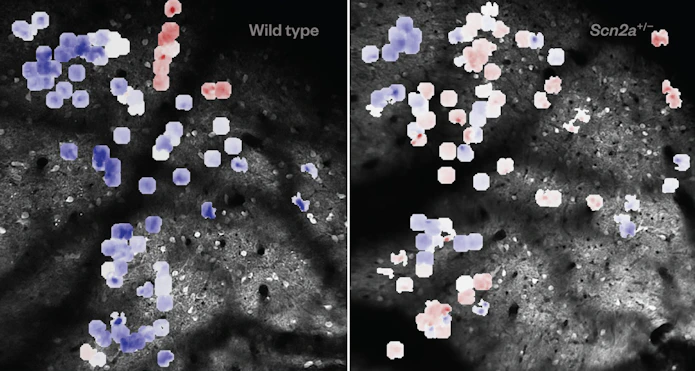
In control mice, neurons in the SC gradually decreased their activity in response to stimulus patterns that reliably predicted non-threatening outcomes, consistent with an adaptive filtering mechanism. When the researchers reduced the predictability of the stimuli, neuronal responsiveness increased again, allowing flexible behavioral adjustment. This dynamic tuning allowed animals to balance efficiency with vigilance.
In contrast, Scn2a+/– mice showed a different response profile during the learning task. Their SC neurons remained overly active even when stimuli were predictable, and became hyper-responsive under uncertain conditions. This failure to appropriately scale neural activity was mirrored at the behavioral level, indicating impaired context-dependent learning.
Importantly, these abnormalities were linked to disrupted signaling from the visual cortex to the SC. When cortical input to the SC was experimentally blocked in control mice, their neurons also lost the ability to adapt to changing stimulus predictability, a phenotype closely resembling that of the autism-model mice.
Together, these findings point to cortical feedback as a critical regulator of contextual learning in the SC. Cortical input seems to calibrate midbrain circuits, shaping how uncertainty and familiarity are translated into action.
This study links a high-confidence autism-associated gene to altered circuit dynamics and learning-related differences in sensory function.
By revealing how disrupted cortical–midbrain communication interferes with the flexible interpretation of environmental cues, this work offers a framework for understanding how genetic risk may contribute to atypical responses to uncertainty. More broadly, it highlights the SC as a site where cortical dysfunction may exert downstream effects on behavior, with implications for both basic neuroscience and autism research.