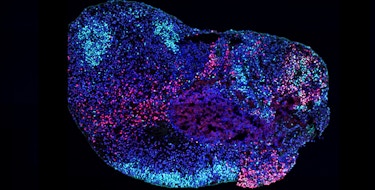
The dorsolateral prefrontal cortex (dlPFC) is essential for higher cognitive functions such as decision-making and planning. It is also frequently implicated in neuropsychiatric conditions, including autism spectrum disorder (ASD)1. From mid-gestation through the late prenatal period, neurons in the dlPFC undergo extensive maturation and circuit formation2. During this same window, many ASD-linked genes are known to be highly expressed3,4, yet their specific contributions to cortical development remain poorly understood.
SFARI Investigator Andre M. M. Sousa and colleagues used a multimodal approach to uncover the molecular programs guiding neuronal maturation. By pairing single-nucleus multiomic analyses, which capture gene expression and chromatin accessibility, with Patch-seq, which jointly measures the electrophysiological, morphological and transcriptomic characteristics of single neurons, they were able to directly connect molecular signatures to functional traits in the primate prefrontal cortex. This integration revealed how specific genes contribute to the electrophysiological properties that underlie the development of cortical excitatory neurons, including resting membrane potential and sodium current dynamics.
Their results highlighted RAPGEF4 (Rap guanine nucleotide exchange factor 4), also known as EPAC2 (exchange protein directly activated by cyclic AMP [cAMP])5, as a central regulator of neuronal maturation. RAPGEF4 is a cAMP-activated signaling protein that helps translate chemical messages into structural and functional changes within neurons. Not only did RAPGEF4 gene expression increase as neurons developed, but reducing its levels in rhesus macaque and human cortical slices led to simplified dendritic architecture and delayed electrical maturation of excitatory neurons. Conversely, overexpressing RAPGEF4 accelerated maturation in human cortical slices at mid-fetal stages.
These findings expand on earlier rodent studies showing that RAPGEF4 mutations disrupt learning and memory through altered dendritic spine remodeling6. Although cAMP-mediated signaling has long been associated with neurological disorders, such as fragile X syndrome7, the role of RAPGEF4 in primate brain development had not been defined until now.
The team next examined CHD8 (chromodomain helicase DNA-binding protein 8), a high-confidence ASD-linked gene that regulates transcription during brain development8,9. Lowering CHD8 expression in human and macaque cortical slices hindered neuronal maturation by downregulating multiple genes, including RAPGEF4. Restoring RAPGEF4 expression in CHD8-deficient neurons rescued normal electrophysiological function, positioning RAPGEF4 as a mediator of CHD8-dependent developmental pathways.
Together, these results identify RAPGEF4 as a key molecular regulator orchestrating prefrontal cortical maturation in primates. More broadly, they suggest that disruption of RAPGEF4-dependent signaling may contribute to the neurodevelopmental mechanisms underlying autism.
- Pattabiraman K. et al. Curr. Opin. Genet. Dev. 65, 91–97 (2020) PubMed
- Silbereis J.C. et al. Neuron 89, 248–268 (2016) PubMed
- Willsey A.J. et al. Cell 155, 997–1007 (2013) PubMed
- Parikshak N.N. et al. Cell 155, 1008–1021 (2013) PubMed
- Bos J.L. Nat. Rev. Mol. Cell Biol. 4, 733–738 (2003) PubMed
- Woolfrey K.M. et al. Nat. Neurosci. 12, 1275–1284 (2009) PubMed
- Berry-Kravis E.M. et al. Nat. Med. 27, 862–870 (2021) PubMed
- Katayama Y. et al. Nature 537, 675–679 (2016) PubMed
- Bernier R. et al. Cell 158, 263–276 (2014) PubMed
Reference(s)
Multimodal analyses reveal genes driving electrophysiological maturation of neurons in the primate prefrontal cortex.
Gao Y., Dong Q., Arachchilage K.H., Risgaard R.D., Syed M., Sheng J., Schmidt D.K., Jin T., Liu S., Sandoval S.O., Knaack S., Eckholm M.T., Chen R.J., Guo Y., Doherty D., Glass I., Levine J.E., Wang D., Chang Q., Zhao X., Sousa A. M. M.