Neurodevelopmental conditions often disrupt neural networks across multiple brain areas. A persistent question in the field is how a single genetic mutation can produce distinct region-specific dysfunction in the brain. In a new Cell Reports study, a team led by SFARI investigator Ranmal Samarasinghe of the University of California, Los Angeles investigates this issue in developmental and epileptic encephalopathy 13 (DEE-13), a rare early-onset epilepsy caused by gain-of-function mutations in SCN8A, the gene encoding the voltage-gated sodium channel Nav1.6. This mutation leads to neuronal hyperexcitability and seizures that are frequently resistant to medication. DEE-13 is also associated with developmental delays, intellectual disability and autism features1,2.
Understanding how a mutation alters the behavior of specific neural circuits is challenging, in part because the brain’s interconnected nature makes it difficult to isolate the contribution of particular brain structures. Access to human brain tissue is limited, and cross-species differences make it difficult for animal models to fully capture human disease mechanisms3.
In DEE-13, seizures stem from overactive cortical networks, while learning and memory problems may arise from dysfunction in hippocampal neurons. How these distinct sources of pathology combine to produce the full clinical picture is unclear. A long-standing hypothesis is that seizures themselves cause neural injury, contributing to intellectual disability. However, in some genetic epilepsies, cognitive difficulties arise before seizure onset or even in their absence4,5. This raises the possibility that SCN8A mutations impair cortical and hippocampal circuits independently.
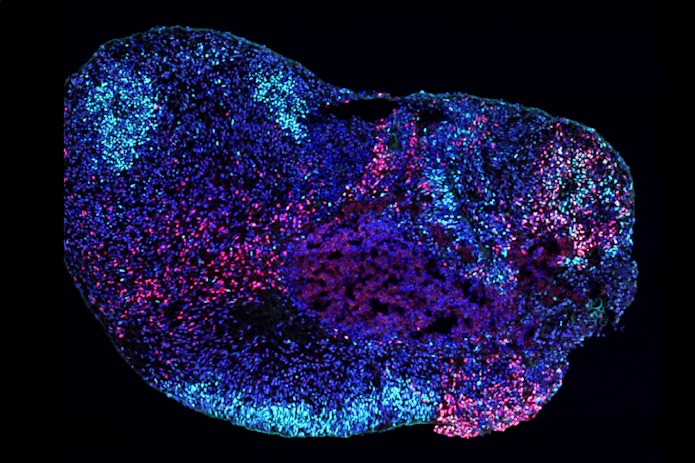
To explore these region-specific effects, the researchers created brain assembloids, fused organoids designed to emulate the interactions between developing brain structures6, starting from patient-derived induced pluripotent stem cells. In the developing mammalian brain, cortical and hippocampal excitatory neurons are born locally, whereas interneurons migrate from the ganglionic eminence. The assembloid approach mirrors this arrangement, allowing the team to interrogate how an individual SCN8A mutation shapes excitatory–inhibitory balance across these neural areas.
In cortical assembloids carrying the SCN8A mutation, the team observed heightened network excitability resembling patterns seen in epileptogenic human cortex. When they examined hippocampal assembloids, they found abnormal electrical activity that closely matched in vivo recordings from human epileptic hippocampi. This suggests that hippocampal dysfunction may arise directly from the mutation, independent of cortical seizure activity, and could help explain the intellectual disability seen in DEE-13.
Further analyses identified a selectively vulnerable subset of inhibitory interneurons in both cortical and hippocampal assembloids, along with an overall increase in excitatory neuron production. Some excitatory neurons also showed altered molecular identity. These findings raise the possibility that enhanced sodium channel activity not only alters neuronal firing but also may influence cell fate decisions. Supporting this idea, earlier studies show that manipulating membrane potential in neural progenitors can shift their differentiation programs7.
Given this developmental component, the authors suggest that it may be difficult to achieve complete disease remission with anti-seizure medications unless treatment begins extremely early, potentially in utero, before neural identities and circuit architecture are established. However, this timing would not help individuals already affected.
One option could be interneuron transplantation, which has shown promise in rebalancing excitatory and inhibitory activity in animal models8. However, findings from this study highlight that the interplay between excitatory and inhibitory neurons is dynamic, and changes in excitatory neurons can themselves reshape interneuron subtype distribution. A recent report supports this, showing that changes to excitatory neuron development can in turn alter interneuron numbers and diversity9. Thus, researchers designing cell-based therapies may need to consider how transplanted interneurons integrate into evolving circuits.
Overall, this work demonstrates that SCN8A mutations underlying DEE-13 disrupt both cortical and hippocampal networks, but in distinct ways. By modeling these effects in human neural assembloids, the study provides new insight into how genetic epilepsies affect multiple brain networks and underscores the need for treatments that address both seizure activity and early developmental abnormalities. These findings may guide future therapeutic approaches not only for DEE-13, but for other neurodevelopmental disorders involving ion-channel dysfunction.
- Genetic and Rare Diseases (GARD) Information Center. Developmental and epileptic encephalopathy, 13 (DEE-13). Accessed 25 November 2025.
- Gardella E. and Møller R.S. Epilepsia 60, S77–S85 (2019) PubMed
- Meisler M.H. Epilepsia 60, S86–S91 (2019) PubMed
- Specchio N. and Curatolo P. Brain 144, 32–43 (2021) PubMed
- Johannesen K.M. et al. Brain 145, 2991–3009 (2022) PubMed
- Wu S.R and Nowakowski T.J. Neuron 113, 33–1150 (2025) PubMed
- Vitali I. et al. Cell 174, 1264–1276.e15 (2018) PubMed
- Hunt R.F. et al. Nat. Neurosci. 16, 692–697 (2013) PubMed
- Wu S.J. et al. bioRxiv (2025) Preprint
Reference(s)
Cortical versus hippocampal network dysfunction in a human brain assembloid model of epilepsy and intellectual disability.
McCrimmon C.M., Toker D., Pahos M., Cao Q., Lozano K., Lin J.J., Parent J., Tidball A., Zheng J., Molnár L., Mody I., Novitch B.G., Samarasinghe R. A.