Roughly one in 36 children in the United States and one in 100 worldwide are diagnosed with autism spectrum disorder (ASD)1,2. Early identification is key to effective intervention and improved quality of life. Yet diagnosis often comes late, in part because there are no reliable biomarkers or standardized clinical tests3,4. Conditions such as attention-deficit/hyperactivity disorder (ADHD) co-occur with ASD in an estimated 50–70% of cases5, further complicating diagnosis and contributing to delays6. Objective tools that can help distinguish between ASD and overlapping conditions are therefore urgently needed.
Motor mimicry helps children to forge and maintain social connections. And studies suggest that children with ASD show reduced imitation compared to neurotypical peers7,8. Motor learning tasks that rely on visual feedback, such as catching a ball, also tend to be more challenging for children with ASD than for those with ADHD. Likewise, difficulties with developmental coordination, or dyspraxia9,10, are more pronounced than in ADHD. These observations suggest that there is a motor profile specific to those with ASD that could potentially aid in diagnostic assessments.
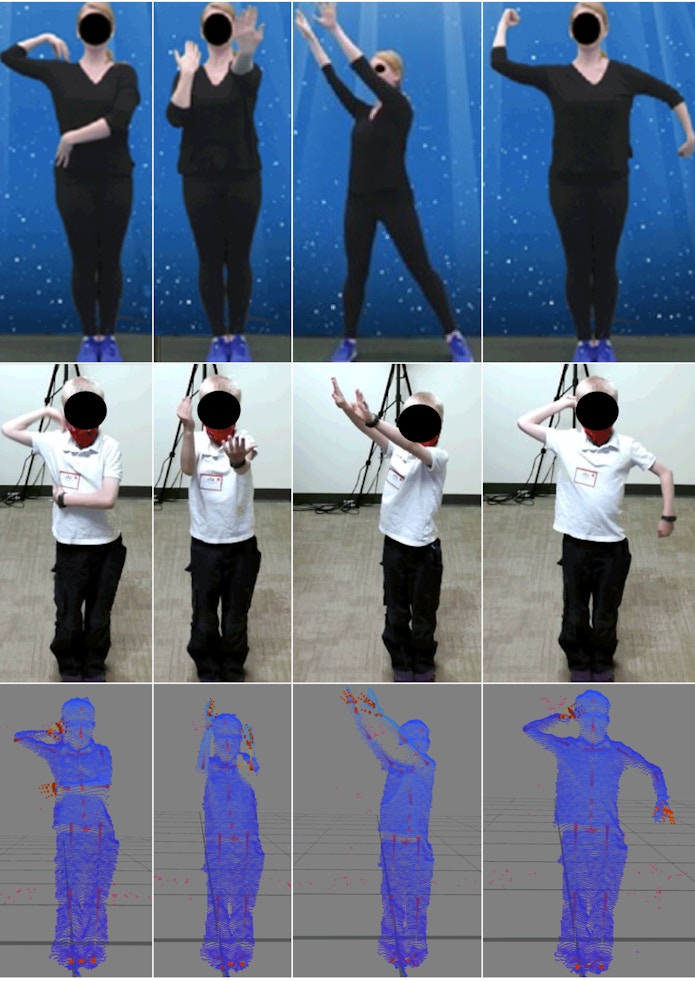
To establish motor imitation as a reliable biomarker, however, highly sensitive and precise methods are essential. Although human observation has been used for decades, it can be inconsistent and subjective. In the current study, published in The British Journal of Psychiatry, SFARI Investigator Stewart Mostofsky (Johns Hopkins University) and colleagues tested whether a video game–like platform, the Computerised Assessment of Motor Imitation (CAMI), could detect imitation difficulties specific to autism. The system uses computer vision rather than wearable sensors to track movement. In two one-minute trials, participants were asked to imitate an on-screen avatar performing whole-body dance movements, and their movements were then automatically scored. In previous work, the researchers had found that CAMI differentiated autism spectrum disorder (ASD) from neurotypical development more accurately than traditional human coding methods11,12.
The researchers analyzed CAMI scores from 183 children aged 7–13, divided into four groups: neurotypical (n = 65), ASD-only (n = 21), ADHD-only (n = 35) and ASD with ADHD (n = 63). Children with ASD (with or without co-occurring ADHD) performed worse on CAMI than neurotypical peers, whereas children with ADHD alone performed comparably to the neurotypical group. The lack of a significant difference between the ADHD-only and ASD-only groups may reflect the relatively small ASD sample size, according to the study’s authors. The team also observed that lower imitation accuracy correlated with higher scores on the Autism Diagnostic Observation Schedule, Second Edition (ADOS-2), a standard measure of autism traits. Overall, CAMI reliably distinguished autism from other developmental profiles, supporting its potential as a scalable, objective biomarker for ASD-related differences. Further research will be needed to evaluate its performance in younger children and in those with more profound or nonverbal autism.
References
- Centers for Disease Control. Data and Statistics on Autism Spectrum Disorder Prevalence. Accessed 18 November, 2025.
- Zeidan J. et al. Autism Res. 15, 778–790 (2022) PubMed
- Grzadzinski R. et al. Mol. Autism 7, 7 (2016) PubMed
- Krakowski A.D. et al. Mol. Autism 11, 28 (2020) PubMed
- Rong Y. et al. Res. Autism Spectr. Disord. 83, 101759 (2021) Online
- Malwane M.I. et al. Cureus. 14, e25825 (2022) PubMed
- Bhat A.N. et al. Phys. Ther. 91, 1116–1129 (2011) PubMed
- Lidstone D.E and Mostofsky S.H. Pediatr. Neurol. 122, 98–105 (2021) PubMed
- Ament K. et al. J. Autism Dev. Disord. 45, 742–751 (2015) PubMed
- MacNeil L.K. and Mostofsky S.H. Neuropsychology. 26, 165–171 (2012) PubMed
- Tunçgenç B. et al. Biol. Psychiatry Cogn. Neurosci. Neuroimaging 6, 321–328 (2021) PubMed
- Lidstone D.E. et al. Res. Autism Spectr. Disord. 87, 101840 (2021) PubMed
Reference(s)
Evaluating Computerised Assessment of Motor Imitation (CAMI) for identifying autism-specific difficulties not observed for attention-deficit hyperactivity disorder or neurotypical development
Santra R., Pacheco C., Crocetti D., Vidal R., Mostofsky S. H., Tunçgenç B.